


SuiteCommerce vs Shopify for NetSuite
byBruno Galo · Published on 29 Sept 2026
Should a NetSuite company sell through NetSuite's own SuiteCommerce, or through Shopify connected to NetSuite? Almost every comparison is written by a firm that builds one of the two. We build neither storefront and resell neither licence; we connect NetSuite to e-commerce platforms. So this guide looks at the side that usually decides it: where the integration work ends up, and who owns it after go-live.
Short answer. SuiteCommerce is NetSuite's own storefront. It runs on the same data as the ERP, so there is no connector to build or monitor, but the storefront and app ecosystem are narrower. Shopify is a separate commerce platform with a larger ecosystem and a faster launch, but orders, stock, prices, customers, refunds and payouts have to be synced with NetSuite by a connector someone has to own.
- Pick SuiteCommerce when most revenue is B2B, pricing is customer-specific and NetSuite is already the centre of everything.
- Pick Shopify + integration when the storefront drives revenue, or you are already on Shopify.
- Consider both (a Shopify storefront plus SuiteCommerce MyAccount for B2B self-service) when B2C and B2B customers need very different experiences.
Prices and plan details in this article were checked on 29 September 2026. They change; the sources are linked so you can check them again.
The real difference: where the integration lives
SuiteCommerce reads and writes NetSuite records directly. There is one item record, one customer record and one sales order. NetSuite describes its commerce products as giving a single source of item, inventory, customer and order data (NetSuite Commerce, checked September 2026). An order placed online already exists in the ERP.
Shopify keeps its own copies of products, prices, stock levels, customers and orders. A connector keeps those copies in step with NetSuite: orders flow in, stock and prices flow out, fulfilments go back to Shopify, refunds come back to NetSuite. Each flow can fail quietly, and someone has to notice.
Put simply: with SuiteCommerce, the integration is NetSuite's problem. With Shopify, it is yours, or your partner's.
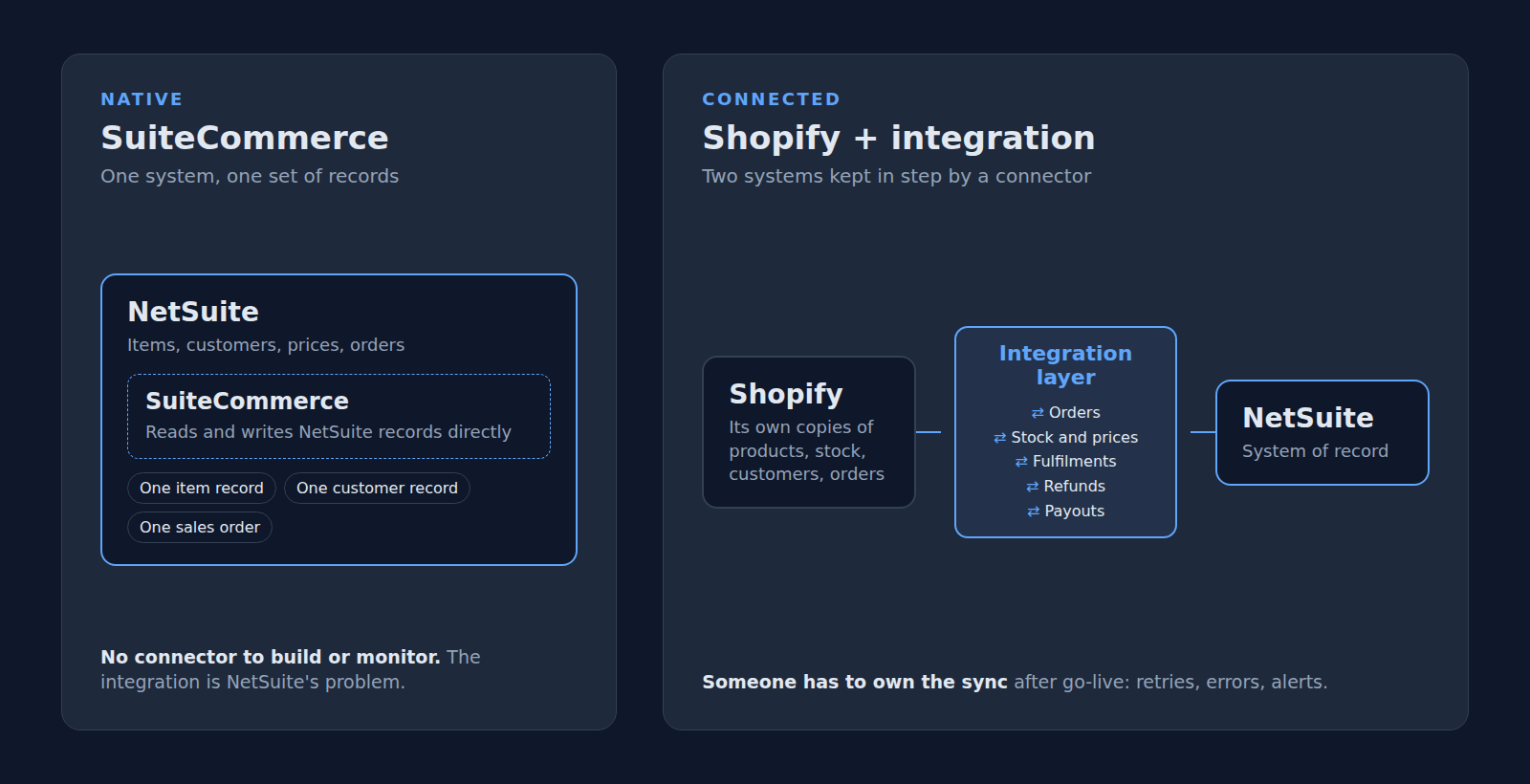
That is why the storefront comparison matters less than it seems. Customers see the storefront; finance and operations live with the integration.
What SuiteCommerce is (and the three editions people mix up)
"SuiteCommerce" is used loosely for three products, and the difference decides who does the upgrades.
- SuiteCommerce runs from a managed bundle. You cannot modify its source code, but NetSuite updates your site automatically. You customise it with themes, extensions and Site Management Tools (Oracle, Benefits of the Extension Framework).
- SuiteCommerce Advanced (SCA) runs from an unmanaged bundle, with full control of the source code. Updates are not pushed to your site; you migrate to new releases yourself (Oracle, Commerce Patches and Upgrades; Oracle, Migrate SuiteCommerce Advanced).
- SuiteCommerce MyAccount (SCMA) is a self-service customer portal with no web store or checkout. Customers can manage account information, pay invoices, view transactions and balances, and manage support cases and quotes (Oracle, SuiteCommerce Solutions).
| Edition | What you can customise | Who handles upgrades |
|---|---|---|
| SuiteCommerce | Themes, extensions, Site Management Tools; not the source code | NetSuite, automatically (managed bundle) |
| SuiteCommerce Advanced (SCA) | Everything, including the source code | You, by migrating to each new release (unmanaged bundle) |
| SuiteCommerce MyAccount | Themes and extensions on a self-service portal; no store or checkout | NetSuite, automatically (same managed bundle as SuiteCommerce) |
The SC-versus-SCA choice is the familiar trade-off between configuring and scripting: control now against upgrade work later. We cover it in general terms in when to configure and when to script.
Licensing. NetSuite sells its commerce solutions as add-on modules on the NetSuite subscription (NetSuite Commerce). Oracle publishes no list price. Anyone quoting you a SuiteCommerce price without an Oracle quote is estimating.
What Shopify brings, and what it needs to work with NetSuite
Shopify publishes its plans. The points that matter most to a NetSuite company, from the Shopify pricing page (USD, checked 29 September 2026):
- Shopify Plus starts at $2,300 per month.
- Shopify B2B is available on every plan: up to 3 catalogs on Basic, Grow and Advanced, unlimited catalogs on Plus.
- API rate limits are up to 10x on select APIs on Plus, which matters when a connector moves a lot of orders and stock updates.
- Third-party transaction fees are 0.2% on Plus when you do not use Shopify Payments.
Pricing and currency vary by region, so check the page for your market before you budget.
What Shopify does not do is connect to NetSuite on its own. You pick a route:
- Oracle's NetSuite Connector. It syncs products, pricing, inventory, sales orders and fulfilments between NetSuite and Shopify or Shopify Plus B2C and B2B storefronts and Shopify POS. On the Shopify App Store, plans start at $199.92 per month and the B2B plan is $916.58 per month (Shopify App Store, NetSuite ERP Connector, USD, checked 29 September 2026). Oracle documents the B2B connector's catalog and price-list sync, payment terms and PO numbers (Oracle, Shopify B2B).
- Celigo's Shopify–NetSuite integration app. Its flows include Shopify orders to sales orders, refunds to cash refunds or credit memos, cancellations, fulfilments to item shipments, products and customers (Celigo). We are a Celigo partner.
- A real-time sync platform such as Stacksync, or a custom build against the Shopify Admin API and NetSuite's SuiteTalk web services or RESTlets.
We compare these four routes in detail on our NetSuite + Shopify integration page.
SuiteCommerce vs Shopify side by side
| Criterion | SuiteCommerce | Shopify (+ integration to NetSuite) |
|---|---|---|
| Relationship to NetSuite | Native: runs on NetSuite's own records | Separate platform, connected by a connector |
| Source of truth for stock, prices, customers | NetSuite, with nothing to copy | NetSuite should be; Shopify holds synced copies |
| B2B features | Catalogs, pricing, discounts and payment terms by customer or account, per NetSuite | B2B catalogs on every plan (up to 3, unlimited on Plus); catalogs, price lists and terms synced by the connector |
| Customer self-service | MyAccount: pay invoices, view transactions and balances, quotes and cases | Shopify B2B customer accounts; invoices and payments synced back to NetSuite |
| Storefront, themes and apps | Narrower theme and extension ecosystem | Much larger theme and app ecosystem |
| Customisation model | Themes and extensions; full source code only on SCA | Liquid themes, apps, and Functions and checkout customisation on Plus |
| Upgrades | SuiteCommerce updated automatically; SCA migrated by you | SaaS, updated by Shopify; the connector updated by its vendor |
| Licensing | NetSuite add-on module, no public price | Public plans, plus the connector licence |
| Time to launch | Depends on the NetSuite project | Usually faster on Shopify |
| What you run after go-live | One system | A store, a connector and the monitoring around it |
Six questions that decide it
- How B2B is your revenue, and how complex is your pricing? If you rely on customer-specific price levels, payment terms, credit limits, quotes and invoice payment, you lean SuiteCommerce, because all of that already lives in NetSuite. Shopify B2B plus a connector that syncs catalogs, price lists and terms also works, but every rule becomes something to sync. More on this in B2B pricing and credit limits.
- Is the storefront a competitive weapon? If you are a DTC brand that lives on content, conversion experiments and marketing apps, you lean Shopify. That is where its ecosystem earns its keep.
- Are you already on Shopify, with the team, apps and SEO equity that come with it? Replatforming to "remove the integration" swaps an integration project for a migration project. Usually the better move is to fix the integration.
- How fresh must stock and prices be, and across how many channels? Overselling is often a question of what counts as available and when stock is reserved, not only of sync speed. See why stock drifts between channels.
- Who will own the integration after go-live? If nobody on your side will, either budget for monitoring and support or choose the option with less to integrate. This is the question most projects skip; we wrote about it in who owns the system after go-live.
- What else must connect anyway? Marketplaces, a 3PL or WMS, payment providers, EDI. If you need an integration layer for those regardless, adding Shopify to it costs less extra. See reconciling payouts and settlements and iPaaS vs point-to-point.
| Your profile | What we would usually lean towards |
|---|---|
| B2B distributor on NetSuite | SuiteCommerce, or Shopify B2B only if the storefront also has to win B2C customers |
| DTC brand on NetSuite | Shopify with a well-built integration |
| Hybrid B2B + B2C | Shopify for B2C, with SuiteCommerce MyAccount or Shopify B2B for trade customers (see the hybrid pattern below) |
| Already on Shopify, adopting NetSuite | Stay on Shopify and invest in the integration |
The costs people forget on each side
No totals here: nobody can give one without seeing your NetSuite account, and the figures in other comparisons are their own estimates. These are the components, and where each price comes from.
SuiteCommerce
- The commerce module licence, quoted by Oracle.
- The theme and extension build.
- Upgrade migrations, if you choose SCA.
- More custom work, because there are fewer off-the-shelf apps.
Shopify
- The plan, which is public.
- Apps.
- The connector licence: public App Store plans for the NetSuite Connector; Celigo and others quote.
- The integration build and configuration.
- Ongoing monitoring and error handling. This is the part most comparisons leave out, and it lasts as long as the store does.
- Payment and third-party transaction fees, per the pricing page.
Compare the running cost over the years you will live with the choice, not the licence in the first year.
If you choose Shopify: what a good NetSuite integration must cover
A Shopify–NetSuite integration is not one sync. It is a set of flows, each with its own failure modes:
- Orders into NetSuite as sales orders or cash sales.
- Stock and availability per location, back to Shopify.
- Products, prices and B2B catalogs.
- Fulfilments and tracking numbers.
- Returns, refunds and cancellations, which is the flow most often designed last (designing the reverse flow).
- Customers and B2B companies.
- Shopify Payments payouts into deposits, so finance can reconcile.
Around the flows: idempotent retries, so a retry never creates a second order; an error queue someone actually reads; alerts; and documented mappings. The architectural options are in four architectures for getting ecommerce orders into your ERP.
Going with Shopify? See how we build and run NetSuite + Shopify integrations.
Can you use both? The hybrid pattern
Some companies split the channels instead. Two common shapes:
- Shopify storefront plus SuiteCommerce MyAccount. Shopify serves B2C and DTC customers. B2B customers use MyAccount, a NetSuite-native portal, to pay invoices, see balances and transactions and work with quotes (Oracle, SuiteCommerce Solutions). The trade-off: two customer-facing tools to run and keep consistent.
- Shopify B2B for ordering, with invoices and payments synced back. Oracle's B2B connector documentation covers invoice posting and subsequent payments (Oracle, Shopify B2B), and the App Store B2B plan lists "Invoice Posting" and "Subsequent Payment Handling". The trade-off: more of your B2B rules become things to sync.
A third path, which some agencies build, is headless: a separate front end with NetSuite or Shopify behind it.
Switching later: SuiteCommerce to Shopify, or Shopify to SuiteCommerce
Switching in either direction means migrating the store: design, redirects and SEO, apps, and customer accounts. Going from SuiteCommerce to Shopify also means building the integration that SuiteCommerce made unnecessary.
Decide on what you will need in three years, not on what hurts this quarter. And if you go with Shopify, design the integration so NetSuite stays the system of record for items, customers, prices and orders; that keeps a later switch possible in either direction.
If you are moving off SuiteCommerce, the NetSuite side of that new integration is the part we handle.
Frequently asked questions
Is SuiteCommerce better than Shopify if we run NetSuite?
Not automatically. SuiteCommerce runs on NetSuite's own records, so there is no connector to build or monitor, which usually suits B2B-heavy, NetSuite-centric operations. Shopify offers a larger storefront and app ecosystem and a faster launch, but needs an integration to NetSuite that someone has to own. The deciding factors are B2B complexity, how much the storefront drives revenue, and who will run the integration.
Does Shopify integrate with NetSuite natively?
Not on its own. You connect them with a connector. Oracle's NetSuite Connector supports Shopify and Shopify Plus B2C and B2B storefronts and Shopify POS, according to its Shopify App Store listing. Alternatives are iPaaS integration apps such as Celigo's Shopify–NetSuite app, real-time sync platforms, or a custom build on the Shopify and NetSuite APIs.
What is the difference between SuiteCommerce and SuiteCommerce Advanced?
SuiteCommerce runs from a managed bundle: you customise it with themes and extensions, you cannot edit the source code, and NetSuite updates the site automatically. SuiteCommerce Advanced (SCA) is an unmanaged bundle with full source-code control, but you migrate to new releases yourself (Oracle NetSuite documentation).
Is SuiteCommerce good for B2B?
It is built for it. NetSuite lets you set catalogs, pricing, discounts and payment terms per customer or account, and SuiteCommerce MyAccount gives customers self-service to pay invoices and view transactions and balances (Oracle). Shopify also offers B2B catalogs, up to 3 on standard plans and unlimited on Plus per its pricing page, but terms and pricing then need syncing with NetSuite.
How much does SuiteCommerce cost compared with Shopify?
Oracle does not publish SuiteCommerce pricing. It is an add-on module on your NetSuite subscription, quoted by Oracle. Shopify publishes its plans; Plus starts at $2,300 per month (Shopify pricing, checked September 2026). With Shopify you also pay for apps, a NetSuite connector and the work to run it, so compare the total running cost, not the licences.
Can I use Shopify for B2C and SuiteCommerce for B2B?
Yes, some companies split the channels. A common variant is a Shopify storefront plus SuiteCommerce MyAccount, NetSuite's self-service portal for invoices, payments, balances and quotes, which has no web store (Oracle). The trade-off is running two customer-facing tools and keeping both consistent with NetSuite.
What has to be synced between Shopify and NetSuite?
Typically orders, stock and availability per location, products and prices (including B2B catalogs), fulfilments and tracking, returns, refunds and cancellations, customers, and Shopify Payments payouts for reconciliation. Each flow needs retries, error handling and alerts, or problems surface weeks later in finance.
Should we move from Shopify to SuiteCommerce to get rid of integration problems?
Usually not as a first step. Replatforming swaps an integration project for a store migration: design, apps, SEO and customer accounts. Most integration problems come from design choices, such as the source of truth, how available stock is defined and the reverse flow for refunds, and from a lack of monitoring. Those can be fixed without changing platform.
How long does it take to connect Shopify to NetSuite?
It depends on the flows and on how much customisation your NetSuite account has. We aim for a first flow live in weeks rather than months, with the full scope fixed after mapping the flows in a blueprint. Treat any fixed timeline quoted without seeing your NetSuite setup with caution.
Who can help us decide between SuiteCommerce and Shopify in Europe?
Look for someone who does not sell only one of the two. Atypical Tech is an integration engineering firm based in Spain that connects NetSuite with e-commerce platforms, is a Celigo and Stacksync partner, and works in English, Spanish, Portuguese and Catalan. We do not resell SuiteCommerce or Shopify licences.
Not sure which fits? Bring your setup
Tell us how you sell today (channels, B2B and B2C mix, what is in NetSuite) and we will tell you, straight, which option we would pick and what the integration work would be.
Book a 30-min call · 30 minutes · No commitment · English, Spanish, Portuguese and Catalan
Already leaning towards Shopify? Read about our NetSuite + Shopify integration work, or see all the systems we connect.
About the author
Bruno Galo is the founder of Atypical Tech, an integration engineering firm in Spain that connects NetSuite with CRMs, e-commerce platforms and the rest of a mid-market company's systems. Atypical Tech is a Celigo and Stacksync partner and does not resell SuiteCommerce or Shopify.
LinkedIn: https://www.linkedin.com/in/brunogd
Sources
- Oracle NetSuite, NetSuite Commerce — https://www.netsuite.com/portal/products/suitecommerce.shtml (checked September 2026)
- Oracle NetSuite documentation, Benefits of the Extension Framework — https://docs.oracle.com/en/cloud/saas/netsuite/ns-online-help/section_161730713682.html
- Oracle NetSuite documentation, Commerce Patches and Upgrades — https://docs.oracle.com/en/cloud/saas/netsuite/ns-online-help/bridgehead_4043708822.html
- Oracle NetSuite documentation, Migrate SuiteCommerce Advanced — https://docs.oracle.com/en/cloud/saas/netsuite/ns-online-help/subsect_1559073362.html
- Oracle NetSuite documentation, SuiteCommerce Solutions — https://docs.oracle.com/en/cloud/saas/netsuite/ns-online-help/bridgehead_4411478210.html
- Oracle NetSuite documentation, Shopify B2B (NetSuite Connector) — https://docs.oracle.com/en/cloud/saas/netsuite/ns-online-help/section_0217123750.html
- Shopify, Pricing — https://www.shopify.com/pricing (checked 29 September 2026)
- Shopify App Store, NetSuite ERP Connector — https://apps.shopify.com/oracle-netsuite (checked 29 September 2026)
- Celigo, Shopify–NetSuite integration template — https://www.celigo.com/integrations/shopify-netsuite/ (checked 29 September 2026)
Comments
No comments yet.
Leave a comment
Your comment will be reviewed before publishing.
Controller: Atypical Tech S.L. Purpose: to answer your enquiry. Legal basis: your consent. Rights: access, rectification, erasure and the others described in the policy, by writing to hello@atypicaltech.com.