









In short: there are four ways to connect Shopify and NetSuite: Oracle's NetSuite Connector, Celigo's Shopify–NetSuite integration app, real-time sync with Stacksync, or a custom build against the APIs. The right one depends on your volume, the latency you need, how much of your process is non-standard and who will maintain it. We map your flows first, then choose.
When Shopify and NetSuite don't talk, your team becomes the connector
It usually starts small. Someone re-keys Shopify orders into NetSuite, or imports a CSV every morning. Then stock in Shopify drifts away from NetSuite, so you oversell a line on Friday and hide sellable stock on Monday. A refund gets done twice, once in each system, and still doesn't match the credit memo. Finance receives a Shopify Payments payout it can't tie back to the orders inside it. The same customer exists three times.
None of this is a software problem on its own. It is a design problem: nobody decided which system owns which record, or what happens when a sync fails at 2 a.m. Some brands already have a connector that "mostly works" and throws errors nobody owns. Others have a script a freelancer wrote that nobody can maintain. Either way, every increase in sales turns into more admin work.
What we sync between Shopify and NetSuite
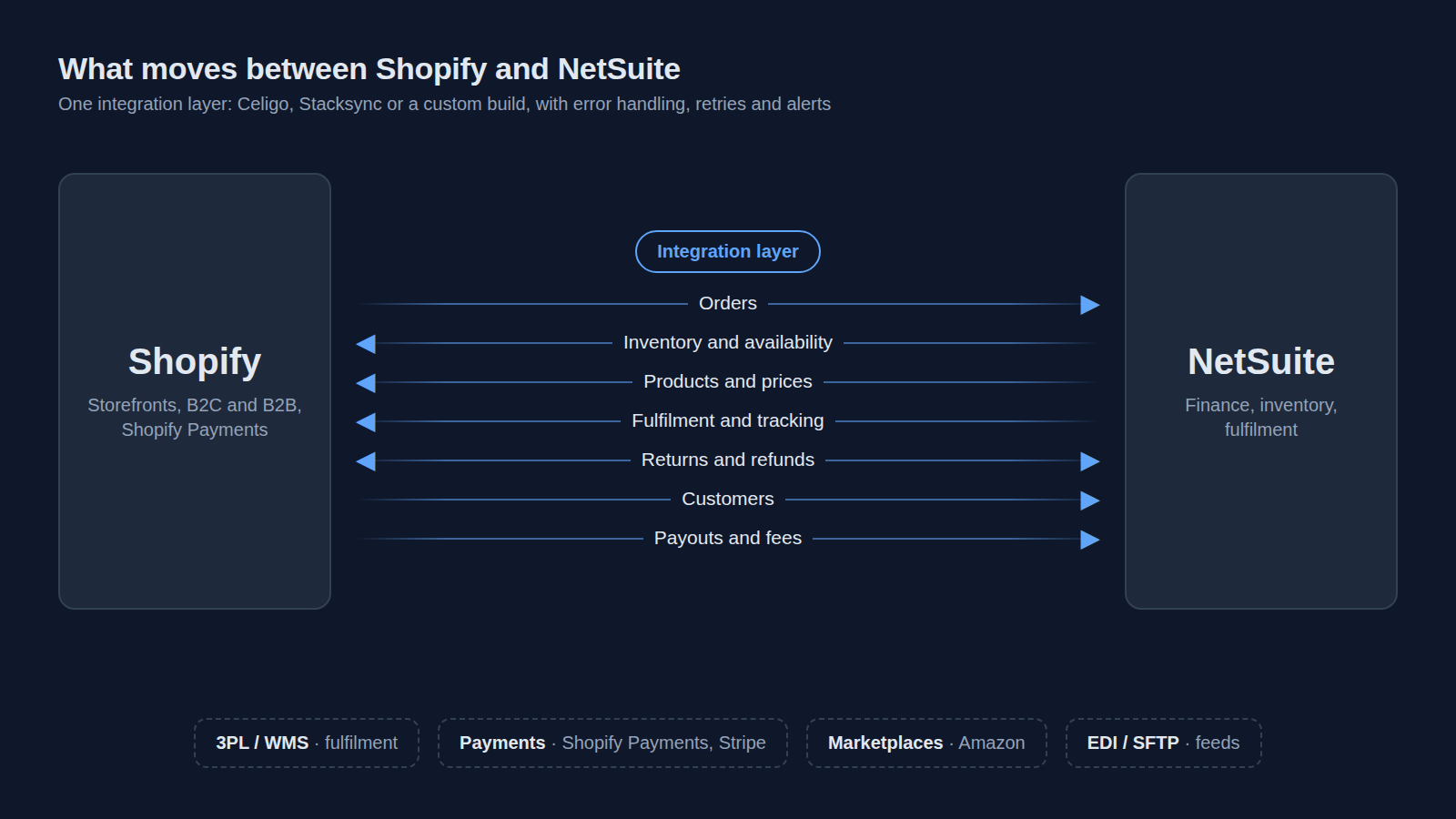
| Flow | Direction | What it covers | What usually goes wrong, and how we handle it |
|---|---|---|---|
| Orders | Shopify → NetSuite | Sales order or cash sale, depending on your process; taxes, discounts, shipping, gift cards; multi-store and B2B orders | Duplicates when a sync retries. We use idempotent keys and an error queue, so a retry never creates a second order. |
| Inventory and availability | NetSuite → Shopify | Available quantity per location, and what counts as available: on hand, committed, in transit | Overselling at peak. We decide the source of truth and the reservation logic before writing a single mapping. |
| Products, prices and catalogue | Usually NetSuite → Shopify | SKUs, variants, prices, B2B price lists | Variants that don't map cleanly to NetSuite matrix items. We agree the item model first. |
| Fulfilment and tracking | NetSuite (or 3PL/WMS) → Shopify | Item fulfilment, carrier, tracking number, partial shipments | Partial shipments that close the whole order. We sync line by line. |
| Returns, refunds and cancellations | Shopify ↔ NetSuite | Return authorizations, credit memos or cash refunds, exchanges, restocking | The reverse flow is left for later. We design it before go-live. |
| Customers | Shopify → NetSuite (and back for B2B) | Deduplication rules, B2B companies and payment terms | Duplicate customers. We set the matching rules up front. |
| Payouts and reconciliation | Shopify Payments → NetSuite | Payouts, and marketplace settlements, posted as deposits with fees | Payouts finance can't reconcile. Each deposit carries its orders, refunds and fees. |
Three flows deserve a closer look. Stock drift is rarely about sync speed; we explain why stock drifts between channels. Returns are where most integrations crack, which is why we insist on designing the reverse flow early. And payouts are a finance problem as much as a data one: see reconciling payouts and settlements. If you sell B2B on Shopify, the same logic applies to B2B pricing and credit limits.
Shopify and NetSuite are rarely alone. 3PLs, warehouse systems, EDI and SFTP feeds, Amazon, Stripe: if it has an API, it can be connected. See all the systems we connect.
Four ways to connect Shopify and NetSuite, and how we choose
| Route | Best when | Watch out for | Who runs it |
|---|---|---|---|
| NetSuite Connector (Oracle) | Standard B2C or B2B flows with little customisation | Processes that don't fit its standard mappings | Your team, inside NetSuite |
| Celigo Shopify–NetSuite integration app | You want a vendor-backed app you can configure and extend with custom flows | Licence cost; you still need someone who understands both the platform and NetSuite | A managed platform, operated by us or by your team |
| Real-time sync with Stacksync | Two systems must agree continuously: inventory, customers | Only worth it where latency really matters | A managed platform, operated by us or by your team |
| Custom build against the APIs | Volume, latency, data residency or unusual logic rule out a platform | You own the code, so it must be documented and monitored | Us, or your team once trained |
NetSuite Connector
Oracle's prebuilt connector. NetSuite's product page lists Shopify B2C and Shopify B2B among its connectors, with products, prices and stock managed in NetSuite and orders and customers coming back from the store. It is a sound choice for standard flows. Complex refunds, several subsidiaries, B2B pricing rules or custom records are where brands usually need more.
Celigo Shopify–NetSuite integration app
As a Celigo implementation partner, we deploy Celigo's prebuilt integration apps, NetSuite–Shopify among them, configured to your processes. You get a vendor-backed connector on a managed platform, plus custom flows where your process departs from the standard. Celigo keeps extending the app: its 2026.1.1 release notes describe Shopify returns creating NetSuite return authorizations and a GraphQL-based refund import. Celigo flows can run on a schedule or on events, so we use near real time where it's needed, not everywhere.
Real-time sync with Stacksync
When two systems must agree continuously, such as stock or customer records, we use real-time sync with Stacksync: bidirectional, sub-second sync with conflict resolution and automatic error recovery.
Custom build against the APIs
The Shopify Admin API (GraphQL) and webhooks on one side, NetSuite SuiteTalk and RESTlets on the other, written in our own stack: no third-party licence in the middle and no connector limits to design around. We choose it when volume, latency, data residency or unusual logic rule out a platform. Where a process needs approvals or several steps, we add n8n for the orchestration.
Which one we use follows your case: the volume, the latency you need, whether the data can leave your infrastructure, and what your team will maintain afterwards. We are not resellers, and the recommendation follows your case, not a quota. For the deeper architecture comparison, read four architectures for getting ecommerce orders into your ERP and iPaaS vs point-to-point.
Not sure which route fits? Book a 30-min call and bring your current setup.
How a NetSuite–Shopify project runs
- Discovery call (30 minutes). Your systems, your manual processes, and where automation pays off fastest.
- Integration blueprint. We map the flows, choose the route and give you a fixed scope with effort and timeline.
- Build and test in a sandbox. With your real data, iterating until the edge cases are covered: refunds, partial fulfilments, several stores, B2B.
- Go-live and monitoring. We deploy, watch the first syncs closely and stay on.
Expect weeks rather than months for a first live flow. The full scope and its timeline are fixed in the blueprint, not guessed before it.
After go-live: monitoring, errors and ownership
Most integrations don't fail on day one. They fail on a busy Saturday, silently, and someone notices on Tuesday. That is why error handling, retries and alerts ship with the integration, not as an upsell after the first silent failure.
After go-live, we monitor the flows in production, handle errors and retries, and evolve them as your processes change. If you'd rather own them, we train your team to. Either way the flows are documented, with no black boxes, so you are never left with something nobody understands.
We also take over existing Shopify–NetSuite integrations, whether a connector or a custom script, that nobody owns any more. We review what is there, fix what breaks, and document it.
Why brands work with Atypical Tech on NetSuite and Shopify
- NetSuite depth, not just plumbing. We're NetSuite specialists who live in ERPs daily. We understand the records, the processes and the finance behind every flow.
- Senior engineers only. The people who scope your project are the ones who build it.
- Partner where it helps, independent where it counts. We are an Authorized Celigo Partner and a Stacksync partner, and we still build directly against the APIs when no platform fits.
- Based in Spain, working across Europe. In English, Spanish, Portuguese and Catalan, in your timezone. More about who we are.
Once your data is in sync, you can put it to work: an AI agent for inventory exceptions is a natural next step.
Sources
- NetSuite, NetSuite Connector: Shopify B2C and B2B listed among the connectors. Checked 29 September 2026.
- Celigo Help Center, Shopify – NetSuite integration app release notes, 2026.1.1: return authorizations for returned items and a GraphQL-based refund import. Checked 29 September 2026.