


Salesforce to Snowflake Real-Time Sync Without Heroku Connect: A Direct Path for RevOps and Analytics Teams
byBruno Galo · Published on 15 May 2026
Last updated 07 Aug 2026
Heroku Connect only supports Heroku Postgres — it cannot write directly to Snowflake. RevOps and analytics teams that need Salesforce data in Snowflake at sub-minute latency have three options: Salesforce Data Cloud's zero-copy share, batch ELT (Fivetran, Airbyte) at 5-minute to 1-hour cadence, or real-time CDC at 30 seconds to 2 minutes. Most teams pick the third.
Why this is a question now
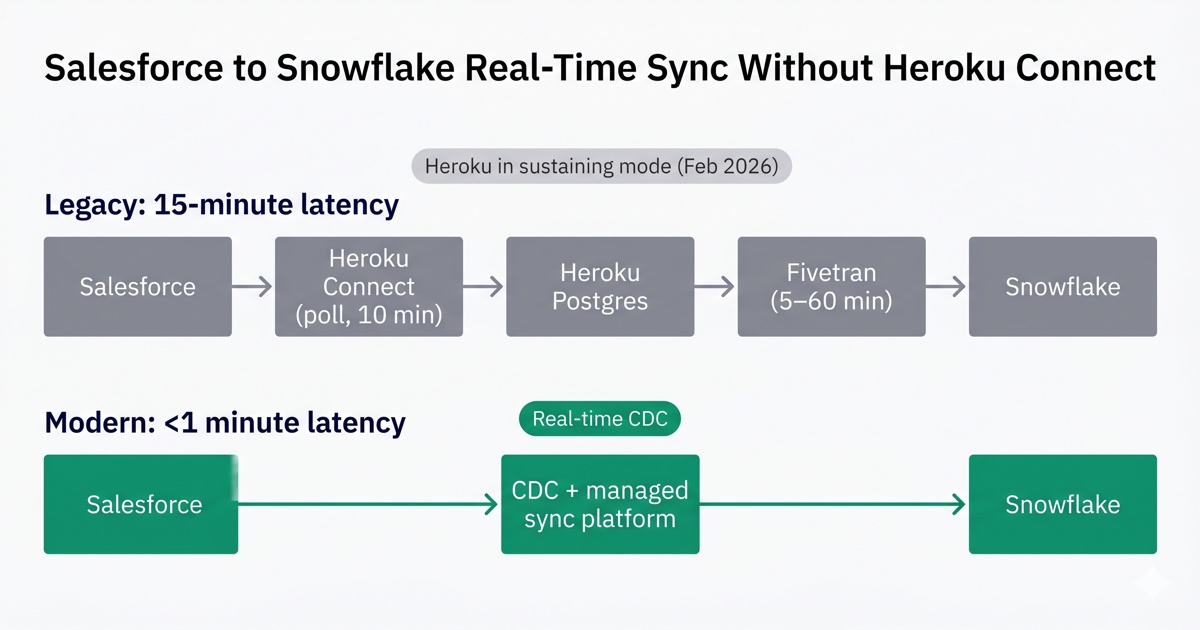
The legacy pattern was: Salesforce → Heroku Connect → Heroku Postgres → Fivetran → Snowflake. Two hops, latency at every layer, two vendor relationships. It works, but it is overbuilt for analytics — and it bottoms out at roughly 15-minute latency end-to-end.
Two things changed.
First, Heroku Connect cannot write to Snowflake natively. It only writes to Heroku Postgres, per the standard Heroku Connect documentation. Teams that wanted Snowflake had to put Heroku Postgres in the middle as a relay, paying for both products and adding latency.
Second, Salesforce's sustaining-mode decision in early 2026 changed the calculus on whether to keep that relay running at all. Coverage in Salesforce Ben confirmed that new Enterprise sales are paused and feature work is frozen. For analytics teams running the legacy two-hop pattern, the question is now: keep paying for Heroku Postgres as a relay, or go direct to Snowflake? For full timeline context, see our companion post on Heroku Connect end of life.
Sub-minute latency on warehouse data is table stakes for revenue analytics. Heroku Connect's 10-minute floor plus Fivetran's 5-minute-to-1-hour cadence cannot deliver that. The architecture has to change.
The three paths from Salesforce to Snowflake
Path 1 — Salesforce Data Cloud zero-copy share
Salesforce Data Cloud supports a zero-copy data share with Snowflake — Snowflake queries Salesforce data without copying it into a Snowflake table. Latency is near-real-time at query time; data lives in Salesforce, Snowflake materializes it on demand.
Strengths: no data duplication, no ELT pipeline to maintain, governance and lineage handled in Data Cloud. Weaknesses: requires Salesforce Data Cloud licensing (a separate SKU), read-only on the Snowflake side, and the access patterns are query-time rather than streaming. Best for analytics teams already on Data Cloud.
Path 2 — Batch ELT (Fivetran, Airbyte, Stitch)
The conventional analytics pattern. Fivetran or Airbyte runs on a schedule (5 minutes to 1 hour) extracting from Salesforce via Bulk API 2.0 or REST, loading into Snowflake. Per-row pricing typically; reliable at scale.
Strengths: mature tooling, strong connector library, easy operational model. Weaknesses: batch latency floor (5-minute to 1-hour cadence), per-row pricing scales with volume, no bidirectional path. Best when latency tolerance is ≥15 minutes and the use case is one-way analytics.
Path 3 — Real-time CDC platforms (Stacksync, Hightouch, Whalesync)
A managed CDC platform subscribes to Salesforce CDC events via the Pub/Sub API, applies them to a Snowflake landing schema in near-real-time. Latency is typically sub-minute end-to-end — most platforms land at 30 seconds to 2 minutes from a Salesforce record changing to a Snowflake row updating. Some platforms (Stacksync) also support reverse-ETL — writing scores or enriched data back to Salesforce — without a separate tool.
Strengths: sub-minute latency, single platform for forward and reverse paths, transparent subscription pricing. Weaknesses: newer category than batch ELT, narrower vendor selection. Best for real-time analytics, multi-destination needs, and reverse-ETL use cases.
Side-by-side comparison
| Path | Latency | Bidirectional | Cost model | Best for |
|---|---|---|---|---|
| Data Cloud zero-copy share | Near-real-time (query-time) | No (read-only on Snowflake) | Salesforce Data Cloud license | Customers already on Data Cloud |
| Batch ELT (Fivetran, Airbyte) | 5 min – 1 hour | No | Per-row / per-connector | Cost-conscious, latency tolerance ≥ 15 min |
| Real-time CDC platform | < 1 minute | Yes (some) | Subscription | Real-time analytics, reverse-ETL needs, multi-destination |
The decision usually comes down to one question: is sub-minute latency a hard requirement?
When zero-copy share wins
Three signals.
You are already on Data Cloud. The license is sunk cost. The zero-copy share pattern is included or trivially priced. Build no ELT pipeline.
Your analytics is read-only. No reverse-ETL. No model scores written back to Salesforce. Pure query workloads in Snowflake against Salesforce data. The zero-copy pattern fits perfectly.
Strong governance and lineage requirements. Data Cloud handles row-level access controls and lineage in a way that ELT pipelines need to replicate manually. Regulated industries get this for free.
When batch ELT wins
Latency tolerance ≥ 15 minutes. Most BI dashboards do not need sub-minute freshness. If your analytics team is OK with 15-minute-old Salesforce data, Fivetran or Airbyte is mature and predictable.
Single destination, one-way. No reverse-ETL planned. No second destination (Snowflake plus Postgres, plus a third). Simple unidirectional analytics.
Cost is the primary constraint. At low-to-mid volume, Fivetran and Airbyte are price-competitive. Above 5M Salesforce records per day, the per-row pricing typically inverts and managed CDC becomes cheaper.
When real-time CDC wins
Sub-minute latency on revenue dashboards. RevOps reporting that needs to match Salesforce within 60 seconds. Pipeline-stage attribution that breaks under 15-minute lag. Customer 360 dashboards backing operational tools.
Multiple destinations. Snowflake for analytics + an operational Postgres for application reads + Redis for low-latency caches. A real-time CDC platform fans out one stream to multiple destinations cheaply.
Bidirectional needs. Reverse-ETL of model scores (lead score, churn risk, customer health) back into Salesforce. Most batch ELT tools require a separate reverse-ETL product (Hightouch, Census). Some real-time CDC platforms bundle both directions, including Stacksync's Heroku Connect alternative.
Heroku Connect deprecation forcing re-architecture anyway. The migration is happening. Consolidate on a single real-time platform rather than rebuilding the legacy two-hop pattern with a new vendor.
A reference architecture for real-time Salesforce → Snowflake
The 2026 pattern teams converge on:
- Source: Salesforce CDC. Subscribe to CDC events via Salesforce Pub/Sub API. Sub-second event delivery, 72-hour replay window. For the architectural primer on CDC, see our companion post on Salesforce CDC vs Heroku Connect.
- Initial bulk load. Salesforce Bulk API 2.0 backfills historical records into the Snowflake landing schema. Coordinate with the CDC stream so cutover is exact.
- Sync engine. A managed CDC platform (e.g., Stacksync) handles replay, schema drift, conflict resolution, and reconciliation. Self-hosted alternative is Confluent Salesforce CDC Source connector + custom Snowflake loader; we cover the build-vs-buy tradeoff in build vs buy: replacing Heroku Connect with Debezium, Airbyte, or a managed sync platform.
- Destination: Snowflake landing schema (raw layer). Schema mirrors Salesforce object structure. Updated within seconds of source changes. Marked as the "raw" or "bronze" layer.
- Transformation: dbt / SQL. Models built on top of the raw layer. Standard analytics-engineering pattern. dbt incremental models work cleanly because the raw layer carries CDC metadata (event timestamp, change type).
- (Optional) Reverse-ETL. Write enriched scores from Snowflake back into Salesforce. Either via the same managed CDC platform (if it supports bidirectional) or via a separate reverse-ETL tool.
The result: end-to-end Salesforce-to-Snowflake latency in the 30-second-to-2-minute range, depending on the platform and dbt run cadence. Sub-minute is achievable.
What about Heroku Postgres in the middle?
The legacy pattern was Salesforce → Heroku Connect → Heroku Postgres → Fivetran → Snowflake. Two hops, two products, two vendor relationships, latency stacking at every layer.
Why teams used it: when Heroku Connect launched in 2014, real-time CDC into a warehouse wasn't commercially viable. Fivetran was the right answer for warehouse-side ELT, Heroku Connect was the right answer for the Salesforce-to-database hop. Stacking them was reasonable.
Why teams are removing the Heroku Postgres layer in 2026: the modern pattern (CDC → Snowflake directly) gets sub-minute latency in one hop, with one vendor and one bill. The Heroku Postgres relay adds 10-minute polling latency and Heroku Postgres license costs without solving any new problem. With Heroku in sustaining mode, the operational case for keeping the relay collapses entirely.
The migration sequence most teams follow: migrate analytics first (Salesforce → Snowflake direct), then migrate operational reads (Salesforce → modern Postgres direct), then decommission both Heroku Connect and Heroku Postgres. Analytics is typically lower-risk and faster to validate than operational sync, so it leads.
Concrete RevOps use cases
Where the sub-minute Salesforce-to-Snowflake pattern matters in practice.
Real-time pipeline-stage attribution. Revenue dashboards showing pipeline movement within 60 seconds of a Salesforce stage change. Critical for sales-ops weekly forecasting cycles.
Customer 360 dashboards. Operational tools that show customer state matching Salesforce within sub-minute. Support, success, and account-management workflows depend on this.
Reverse-ETL of model scores. Lead score, churn risk, customer health, propensity-to-buy — computed in Snowflake or a separate ML platform, written back to Salesforce as fields on the Account or Contact object. Sales reps see the score in their Salesforce view; analytics teams own the model.
Multi-org / multi-tenant analytics rollups. SaaS companies running customer-specific Salesforce orgs and rolling them up into a single Snowflake schema for cross-tenant analytics. CDC streams from each org land in tenant-isolated landing tables; dbt models aggregate across them.
Common reasons teams stay on the legacy pattern
Two real ones.
Existing Heroku Postgres workloads. If applications are reading from Heroku Postgres in production, you can't decommission it just because analytics has migrated. The migration sequence becomes: analytics first (Salesforce → Snowflake direct, Heroku Postgres still running for operational reads), then operational reads later (Salesforce → modern Postgres direct), then Heroku Connect off.
Operational apps with low latency tolerance. Some applications cannot tolerate even brief migration windows. The shadow-and-cutover pattern handles this — run the new sync in parallel for 14 days, validate, then cut over write traffic, then read traffic. This pattern is covered in detail in our Heroku Connect end-of-life migration guide and in Stacksync's replacing Heroku Connect for real-time sync playbook.
FAQ
Can Heroku Connect sync to Snowflake?
No. Heroku Connect only writes to Heroku Postgres. To get Salesforce data into Snowflake using Heroku Connect, you have to add a second hop: Heroku Postgres → Fivetran (or similar ELT) → Snowflake. The two-hop pattern works but adds latency and a second vendor. Modern teams skip the Heroku Postgres relay entirely.
What's the lowest-latency way to get Salesforce data into Snowflake?
Real-time CDC platforms (Stacksync, Hightouch, Whalesync) deliver sub-minute latency by subscribing to Salesforce CDC events via Pub/Sub API and writing into Snowflake landing schemas. End-to-end from a Salesforce record changing to a Snowflake row updating: typically 30 seconds to 2 minutes.
Is Salesforce Data Cloud the same as Snowflake?
No. Salesforce Data Cloud is Salesforce's customer-data platform layer. It supports a zero-copy share with Snowflake, meaning Snowflake can query Data Cloud data without copying it. They are separate products that integrate; Data Cloud is not a Snowflake replacement and Snowflake is not a Data Cloud replacement.
Does Fivetran support real-time Salesforce sync?
Not in the sub-minute sense. Fivetran's typical Salesforce sync cadence is 5 minutes to 1 hour, depending on tier and connector configuration. For sub-minute latency, real-time CDC platforms that subscribe to the Salesforce Pub/Sub API are the right shape, not Fivetran.
Can I do reverse-ETL from Snowflake back to Salesforce?
Yes, with the right tooling. Standalone reverse-ETL products (Hightouch, Census) handle this. Some real-time CDC platforms (Stacksync) bundle bidirectional sync, eliminating the need for a separate reverse-ETL tool. Reverse-ETL is the pattern for writing model scores, enriched fields, or aggregated metrics from Snowflake back into Salesforce records.
How does Stacksync compare to Hightouch for warehouse sync?
Hightouch is reverse-ETL-first (Snowflake → Salesforce) with strong activation features. Stacksync is bidirectional-sync-first (Salesforce ↔ Snowflake or Postgres), with both directions in one platform. Choice depends on which direction is the primary use case: if you mostly need warehouse → SaaS activation, Hightouch fits. If you need real-time bidirectional, Stacksync fits.
What's the cheapest way to replace Heroku Connect for analytics?
Two options usually win on cost. (1) Real-time CDC platform writing direct to Snowflake — eliminates the Heroku Postgres relay entirely. (2) Batch ELT (Fivetran, Airbyte) if 15-minute latency is acceptable. Both typically come in below the cost of the legacy Heroku Connect → Heroku Postgres → Fivetran two-hop stack.
Can I run real-time CDC alongside an existing Heroku Connect pipeline during migration?
Yes, and it is the recommended pattern. Run the new CDC platform writing to a separate Snowflake schema or database for 14 days while Heroku Connect continues writing to Heroku Postgres. Reconcile data integrity. Cut analytics traffic to the new pipeline. Migrate operational reads later. Decommission Heroku Connect last.
Closing — Migration sequence
Three steps for analytics-team migration off the Heroku Connect → Heroku Postgres → Fivetran pattern:
- Pick the path. Sub-minute latency required → real-time CDC platform. 15-minute tolerance OK → batch ELT. Already on Data Cloud → zero-copy share.
- Stand up the new pipeline in parallel. Snowflake landing schema, mapped to your Salesforce objects. Run in shadow mode for 14 days. Reconcile against the existing Snowflake schema (whatever you're using today through the legacy two-hop).
- Cut over analytics, then operations. Analytics first — lower risk, easier to validate. Once analytics is stable, plan the operational-reads migration and decommission Heroku Connect.
Stacksync's Heroku Connect alternative covers what the managed-platform path looks like across both analytics and operational use cases.
About the author
Bruno Galo — Founder, Atypical Tech
Bruno Galo is the founder of Atypical Tech, a NetSuite consultancy serving mid-market clients across Iberia. He specializes in connecting CRM and ERP systems for seamless order-to-cash workflows, building automated order management pipelines that eliminate manual data entry between sales and finance teams. As an official Stacksync implementation partner, Bruno designs and deploys AI agents on integration platforms to handle exception routing, document processing, and reconciliation — turning fragmented order flows into reliable, self-monitoring systems.
Sources
- Salesforce Ben — Salesforce Shuts Down Heroku Enterprise Sales: https://www.salesforceben.com/salesforce-shuts-down-heroku-enterprise-sales-for-new-customers/
- Salesforce — Snowflake as a Salesforce Data Cloud partner: https://www.salesforce.com/data/partners/snowflake/
- Salesforce Developers — Change Data Capture: https://developer.salesforce.com/docs/atlas.en-us.change_data_capture.meta/change_data_capture/cdc_intro.htm
- Salesforce Developers — Bulk API 2.0: https://developer.salesforce.com/docs/atlas.en-us.api_asynch.meta/api_asynch/asynch_api_intro.htm
- Snowflake — Data Loading Overview: https://docs.snowflake.com/en/user-guide/data-load-overview
- Heroku Dev Center — Heroku Connect documentation: https://devcenter.heroku.com/articles/heroku-connect
- Fivetran — Salesforce connector: https://www.fivetran.com/connectors/salesforce
Comments
No comments yet.
Leave a comment
Your comment will be reviewed before publishing.
Controller: Atypical Tech S.L. Purpose: to answer your enquiry. Legal basis: your consent. Rights: access, rectification, erasure and the others described in the policy, by writing to hello@atypicaltech.com.