


Heroku Connect vs Celigo vs MuleSoft vs Stacksync: An Integration Architect's 2026 Decision Framework
byBruno Galo · Published on 15 May 2026
Last updated 07 Aug 2026
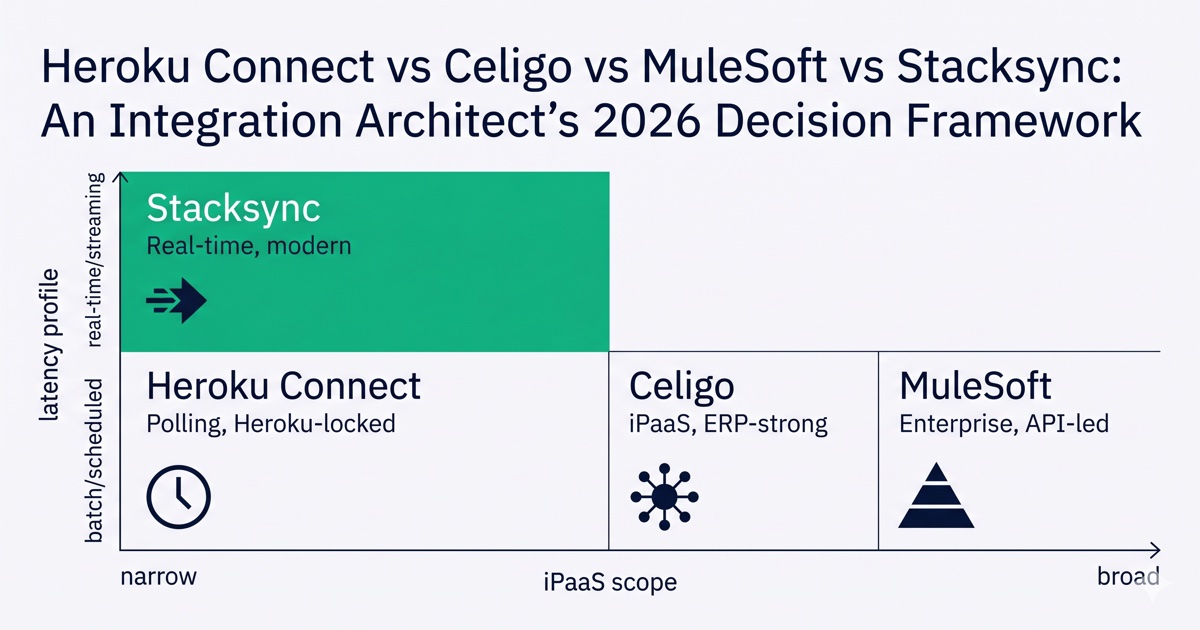
When Salesforce ↔ Postgres sync breaks, integration architects evaluate four platforms: Heroku Connect (legacy, sustaining mode), Celigo (iPaaS), MuleSoft (enterprise iPaaS), and Stacksync (modern bidirectional sync). At 10M synced records, monthly cost ranges from $5K/mo to $50K+/mo depending on platform. Each fits a different stack. Decision framework with side-by-side capability and cost matrices below.
Why this comparison matters in 2026
The four-platform shortlist looks the same as it did in 2023. The reasons to pick each have shifted considerably.
The proximate cause is Salesforce's February 6, 2026 decision to put Heroku into sustaining engineering mode. New Enterprise sales paused; feature work on the platform that hosts Heroku Connect frozen. Coverage from Salesforce Ben and The Register read it the same way: existing customers are unaffected operationally, but Heroku's strategic trajectory is no longer ambiguous. Independent partner analysis points to End of Sale around FY29–FY30. For full timeline context, see our companion post on Heroku Connect end of life.
That single announcement moved the comparison from "which is best for new builds" to "which is best for new builds and which fits a 24-to-36-month migration off Heroku Connect." Architects are running the framework in this post against existing Heroku Connect deployments roughly five times more often than they did in 2024.
Two other shifts matter. iPaaS pricing has compressed for mid-market — Celigo and similar iPaaS vendors now compete more on time-to-value than on enterprise contract size. And modern sync platforms (Stacksync, Whalesync, Bracket) have closed the gap on enterprise observability features that previously made MuleSoft the only "safe" choice for regulated industries. The shortlist hasn't changed; the reasons inside it have.
The four platforms at a glance
| Platform | Architecture | Best for | Sync pattern | Pricing model | Where it struggles |
|---|---|---|---|---|---|
| Heroku Connect | Polling against Heroku Postgres | Legacy Salesforce ↔ Heroku Postgres | Bidirectional, 10-min minimum | Tier-based, ~$5K–$50K/mo at scale | Latency floor, Postgres lock-in, sustaining-mode strategic risk |
| Celigo | iPaaS workflow engine | NetSuite + Salesforce + Shopify ERP stacks | Event/scheduled, both ways | Per-flow + per-record | High-volume real-time, dedicated database sync |
| MuleSoft | Enterprise iPaaS / API-led | Large-enterprise Salesforce + complex integrations | API-led, anything → anything | Enterprise contract ($50K+/yr typical) | Cost-at-scale, time-to-value, simple sync use cases |
| Stacksync | Real-time bidirectional sync platform | Salesforce ↔ any modern Postgres or warehouse | Sub-second bidirectional | Subscription, transparent | New player, narrower iPaaS footprint outside Salesforce |
The table is the headline view. The next four sections give the honest take on each, including where the platform genuinely wins and where it does not.
Heroku Connect — the incumbent for Salesforce ↔ Heroku Postgres
Heroku Connect was the right answer for a specific stack: an application running on Heroku Dynos with a Heroku Postgres database that needs Salesforce data both ways. For that exact stack, it remains the most deeply integrated option.
Strengths. Heroku Connect ships with strong Heroku-platform integration: configuration is part of the Heroku app, mappings are managed in the Heroku dashboard, monitoring shows in the Heroku metrics view. For teams already on Heroku, the cognitive load is low. The product is well-documented in the Heroku Dev Center, and bidirectional writes are reliable for moderate-volume deployments.
Weaknesses. Three are widely understood:
- Latency. The polling architecture's minimum interval is 10 minutes. For analytics this is fine. For operational use cases (lead routing, customer-facing apps reading Salesforce-derived data) it is too slow.
- Postgres lock-in. Heroku Connect writes only to Heroku Postgres. If your roadmap includes RDS, Supabase, Neon, AlloyDB, or any other Postgres host, you will replace Heroku Connect when you move.
- API quota burn. The polling architecture consumes Salesforce streaming API quota, which can throttle other integrations in the same org. Per the Heroku Help center, this is a frequent surprise for teams adding Heroku Connect to an org with existing Salesforce integrations.
The 2026 strategic risk. Heroku is in sustaining mode. Heroku Connect specifically has not shipped major features in years, with the Salesforce API version still defaulting to v56 (Winter '23). Independent migration coverage from reinteractive frames it: "Partners relying on Heroku Connect and App Link are on a clock."
When Heroku Connect still wins. Existing deployments under 5M synced records that are running well, where the team has bandwidth to revisit migration in 12–18 months. Greenfield projects: Heroku Connect would not be the choice today.
Celigo — the ERP-integration heavyweight
Celigo earned its reputation in NetSuite ↔ Salesforce, NetSuite ↔ Shopify, and Dynamics 365 ↔ Salesforce flows. It is an iPaaS-first platform, designed around prebuilt integration "Integration Apps" plus a low-code flow editor.
Strengths. Celigo's prebuilt connector library is unmatched for ERP-centric stacks. NetSuite, Dynamics 365, Shopify, Salesforce, Stripe, and the long tail of ERP-adjacent SaaS — most have well-tested templates. The Integrator.io low-code editor is genuinely usable by senior business-systems analysts, not just engineers. EMEA presence is strong; many mid-market companies in Europe run Celigo as their primary integration layer. The Celigo Salesforce connector covers the standard CRUD operations against Salesforce objects.
Weaknesses. Celigo is not designed as a real-time database sync platform. Most flows run on a 5-minute schedule or are triggered by webhooks. The per-record pricing model scales poorly for high-volume Salesforce sync — you pay per row processed, which is fine for a 50K-record-per-day flow and expensive for a 5M-record-per-day flow.
When Celigo wins. NetSuite-centric or Dynamics-centric stacks where Salesforce is one of many systems, where the team needs ERP-side connector depth more than sub-second sync latency, or where business analysts (not just engineers) will own integration maintenance. Celigo also fits well when the use case is "sync and transform" rather than "maintain a queryable replica" — flows are about moving records with transformations, not maintaining state.
In our work at Atypical Tech with mid-market EMEA clients, Celigo is the right answer for roughly half of the integration projects we see. The other half — Salesforce-centric, real-time, database-target — looks more like Stacksync's territory than Celigo's.
MuleSoft — the enterprise default
MuleSoft is Salesforce's own enterprise iPaaS, acquired in 2018. It is API-led: you build APIs that wrap each system, then compose those APIs into integrations. The model fits enterprises that already have an API strategy and want integration to be a controlled tier of that strategy.
Strengths. Broad connector library (the Anypoint Salesforce connector is comprehensive), enterprise-grade observability, governance and audit trails that satisfy regulated industries, and on-prem / VPC deployment options that mid-market platforms rarely match. For Salesforce-led enterprises, it is the path of least resistance with procurement.
Weaknesses. Enterprise pricing — typical contracts start at $50K+ per year and easily reach $500K+ at scale. Time-to-value is long; a non-trivial Salesforce ↔ Postgres flow can take 8–12 weeks for first production cutover, even with a competent MuleSoft team. The platform is heavyweight for simple sync use cases — using MuleSoft to keep two databases in sync is like using Kubernetes to run a single Docker container. It works, but the operational overhead is disproportionate.
When MuleSoft wins. Large enterprises with existing API-strategy mandates, regulated industries (financial services, healthcare) needing audit-grade observability, or organizations where Salesforce is the system of record for revenue and the integration layer must satisfy SOX / SOC 2 / HIPAA control requirements as a primary criterion.
When MuleSoft loses. Mid-market and SMB. New builds where time-to-value matters. Single-purpose Salesforce-database sync where the cost-to-value ratio is poor.
Stacksync — the modern bidirectional sync platform
Stacksync is purpose-built for real-time bidirectional sync between Salesforce (and other CRMs) and modern databases. The architecture is event-driven on the Salesforce side (Pub/Sub API + CDC) and supports a wide range of destinations: Postgres on RDS, Supabase, Neon, Crunchy Bridge, AlloyDB, plus warehouses like Snowflake and BigQuery.
Strengths. Sub-second bidirectional sync, with conflict resolution configurable per object. Modern destination support — not Postgres-only. Transparent subscription pricing (no per-record charges that surprise at scale). Observability-first product design: schema drift, sync lag, and conflict counts are visible by default rather than as a paid add-on. Migration tooling specifically designed for moving off Heroku Connect — see Stacksync's Heroku Connect alternative landing.
Weaknesses. Newer player than Celigo or MuleSoft, with a narrower iPaaS footprint outside the Salesforce ↔ database use case. If your integration scope spans NetSuite, Dynamics, Shopify, and 30 other SaaS systems, Stacksync is not the iPaaS you replace Celigo with — it is the sync layer you add alongside Celigo for the Salesforce-database part of the stack.
When Stacksync wins. Salesforce-centric data sync at any scale where real-time matters, new builds where Heroku Connect would have been the legacy choice, and migrations off Heroku Connect specifically.
"We've been pushing customers off Heroku Connect for two years already — sustaining mode just made the conversation faster."
— r/SalesforceDeveloper, May 2026
Decision framework — five questions in order
Run these in order. Stop at the first match.
- Is your destination Heroku Postgres specifically? If yes and the deployment is under 5M synced records, Heroku Connect remains workable for 12–18 months while you plan a migration. If yes and the deployment is larger or strategically critical, start migrating now to a modern Postgres host plus Stacksync.
- Is your primary system NetSuite or Dynamics, with Salesforce as one of many? Celigo. The connector breadth and ERP-side depth justifies it. Layer Stacksync on top only if the Salesforce-database sync specifically needs sub-second latency.
- Do you have an enterprise API-led mandate or regulated-industry observability requirements? MuleSoft. The time-to-value cost is real but the procurement and audit alignment usually decides this for you.
- Do you need sub-second bidirectional Salesforce ↔ any modern database, with transparent pricing? Stacksync. This is the modern pattern that displaces both Heroku Connect (latency) and the broad iPaaS platforms (cost).
- Do you have a senior team that wants to self-host CDC? See our companion post on build vs buy: replacing Heroku Connect with Debezium, Airbyte, or a managed sync platform. The economics only invert at very large scale.
Cost comparison at common scales
Indicative ranges based on published pricing and customer references. Get quotes for exact figures.
| Scale | Heroku Connect | Celigo | MuleSoft | Stacksync |
|---|---|---|---|---|
| 100K records, 1 connection | ~$1.5K/mo | ~$1K/mo | ~$5K/mo | <$1K/mo |
| 1M records, 5 connections | ~$5K/mo | ~$3K/mo | ~$15K/mo | ~$2K/mo |
| 10M records, 20 connections | ~$25K/mo | ~$10K/mo | ~$50K+/mo | ~$5–10K/mo |
Two takeaways. Heroku Connect's tier pricing scales steeply once you cross the 5M-row threshold. MuleSoft's per-year enterprise contract typically dominates everything else above 10M rows. Celigo's per-record pricing is competitive at low-to-mid volume and gets expensive at high volume. Stacksync's subscription pricing is roughly linear with connection count and broadly transparent at every tier.
For the deeper Stacksync vs Heroku Connect cost analysis specifically, see Stacksync's Heroku Connect comparison: cost, speed, and scalability.
What integration architects in 2026 actually pick
We see three patterns dominating in 2026 client work.
The new-build pattern. Greenfield Salesforce + database project. Skip Heroku Connect entirely. Decision is between Stacksync (Salesforce-centric) and Celigo (broader ERP scope) — driven by the rest of the stack rather than Heroku Connect at all.
The migrate pattern. Existing Heroku Connect deployment, sustaining-mode announcement triggered re-evaluation. Most often: migrate to Stacksync if the use case is Salesforce ↔ database. Migrate to Celigo if the broader stack is NetSuite-centric or Dynamics-centric. Rarely: migrate to MuleSoft (cost-prohibitive for the typical Heroku Connect scope).
The hybrid pattern. Existing iPaaS investment (Celigo or MuleSoft) plus a need for sub-second Salesforce-database sync that the iPaaS can't deliver economically. Solution: keep the iPaaS for cross-system flows; add Stacksync specifically for the Salesforce-database real-time tier. This is increasingly common in mid-market EMEA clients we work with.
FAQ
What's the difference between Heroku Connect and Celigo?
Heroku Connect is a managed bidirectional sync between Salesforce and Heroku Postgres only, polling on a 10-minute minimum interval. Celigo is a broader iPaaS with prebuilt connectors for NetSuite, Dynamics, Shopify, Salesforce, and other SaaS systems. Heroku Connect maintains a queryable Postgres replica; Celigo executes integration flows. Different shapes, different problems.
Is MuleSoft overkill for Salesforce-Postgres sync?
Usually yes. MuleSoft's enterprise contract and time-to-value make sense when integration is a tier of a broader API strategy or when regulated-industry observability is a hard requirement. For a standalone Salesforce-Postgres sync, MuleSoft is typically more expensive and slower to deploy than a purpose-built sync platform.
Can Celigo replace Heroku Connect?
For some teams, yes. If your use case tolerates 5–15 minute scheduled flows rather than real-time, and if your primary system is NetSuite or Dynamics with Salesforce as one component, Celigo can absorb the Heroku Connect workload. For sub-second bidirectional Salesforce-Postgres specifically, Celigo is not the right shape.
Is Stacksync cheaper than MuleSoft?
Almost always, at every scale. Stacksync's subscription pricing for Salesforce-database sync is typically 50–80% lower than the equivalent MuleSoft contract, because Stacksync is a single-purpose platform and MuleSoft is an enterprise iPaaS with much broader scope. Direct cost comparison only makes sense when scope is comparable.
Which iPaaS is best for NetSuite + Salesforce?
Celigo for most mid-market deployments — the prebuilt NetSuite ↔ Salesforce Integration App is mature, well-supported, and frequently the lowest time-to-value path. MuleSoft is the right choice for large enterprises with API-strategy mandates or regulated-industry observability requirements that justify the contract size. Boomi (not covered in detail here) is a third option with similar positioning to Celigo, slightly stronger on EDI integrations.
Why is Heroku Connect's pricing tier-based?
Heroku Connect packages compute (the polling worker), database (Heroku Postgres tier), and the connector itself into bundled tiers. The pricing reflects all three. The result is that small deployments are reasonable and large deployments are expensive — which is why the typical break-even point for moving off Heroku Connect is around 5M synced records.
Does Salesforce recommend MuleSoft over Heroku Connect?
Salesforce sells both and positions them differently. MuleSoft is recommended for enterprise integration strategy. Heroku Connect is recommended for Heroku-platform applications. With Heroku in sustaining mode, Salesforce's net direction is increasingly toward MuleSoft for new enterprise deals — though for mid-market Salesforce-Postgres sync, MuleSoft is rarely the right shape.
Can I run Heroku Connect and a modern iPaaS in parallel during migration?
Yes, and it is the recommended pattern. Run the new platform in shadow mode (read-only, parallel schema or database) for 7–14 days while Heroku Connect continues to serve production traffic. Reconcile data integrity during the shadow window. Cut over write traffic, then read traffic, then decommission Heroku Connect. We cover this playbook in detail in our Heroku Connect end-of-life migration guide.
Closing — Next steps
Run the five-question decision framework against your actual stack, not against a hypothetical one. If you land on Stacksync after running the framework — the most common outcome for Salesforce ↔ database sync in 2026 — Stacksync's Heroku Connect alternative page is the next step.
If you land on Celigo — common for NetSuite-centric stacks — Atypical Tech's integration practice has implementation experience across NetSuite ↔ Salesforce flows. Get in touch.
About the author
Bruno Galo — Founder, Atypical Tech
Bruno Galo is the founder of Atypical Tech, a NetSuite consultancy serving mid-market clients across Iberia. He specializes in connecting CRM and ERP systems for seamless order-to-cash workflows, building automated order management pipelines that eliminate manual data entry between sales and finance teams. As an official Stacksync implementation partner, Bruno designs and deploys AI agents on integration platforms to handle exception routing, document processing, and reconciliation — turning fragmented order flows into reliable, self-monitoring systems.
Sources
- Salesforce Ben — Salesforce Shuts Down Heroku Enterprise Sales for New Customers: https://www.salesforceben.com/salesforce-shuts-down-heroku-enterprise-sales-for-new-customers/
- The Register — Heroku to PaaSture: https://www.theregister.com/2026/02/09/heroku_freeze/
- reinteractive — Heroku Sustaining Engineering Model: Risks and Migration Guide: https://reinteractive.com/articles/heroku-sustaining-engineering-model-salesforce-risks-and-migration-guide
- Heroku Dev Center — Heroku Connect documentation: https://devcenter.heroku.com/articles/heroku-connect
- Heroku Help — Streaming API rate limit and Heroku Connect: https://help.heroku.com/F6F6FTGZ/why-is-my-heroku-connect-usage-contributing-to-my-salesforce-org-s-streaming-api-rate-limit
- Celigo — Salesforce connector and Integration Apps: https://www.celigo.com/integrations/salesforce/
- MuleSoft — Anypoint Salesforce connector: https://www.mulesoft.com/integration/salesforce
- r/SalesforceDeveloper — Stacksync as a Heroku Connect alternative: https://www.reddit.com/r/SalesforceDeveloper/comments/1qxyypc/stacksync_a_heroku_connect_alternative/
Comments
No comments yet.
Leave a comment
Your comment will be reviewed before publishing.
Controller: Atypical Tech S.L. Purpose: to answer your enquiry. Legal basis: your consent. Rights: access, rectification, erasure and the others described in the policy, by writing to hello@atypicaltech.com.