


Heroku Connect After Salesforce's 2026 Sustaining-Mode: A Migration Guide for Salesforce Architects
byBruno Galo · Published on 15 May 2026
Last updated 07 Aug 2026
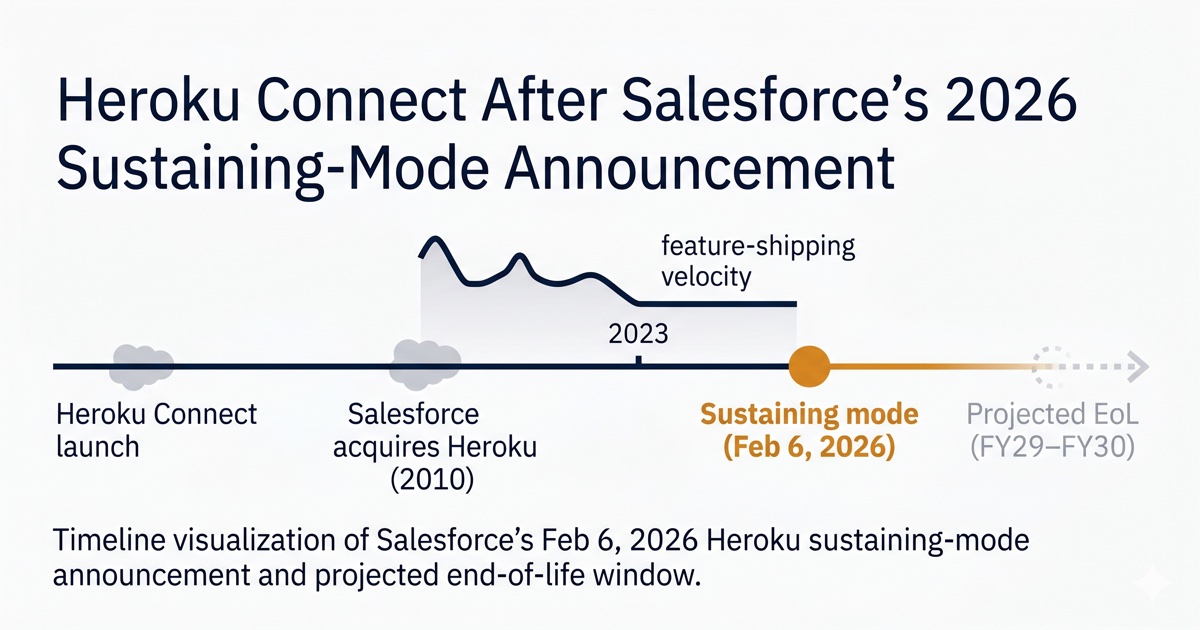
On February 6, 2026, Salesforce moved Heroku into "sustaining engineering mode" — pausing new Enterprise sales and freezing feature work. Heroku Connect is not formally deprecated, but independent analysts project End of Sale around FY29–FY30. Heroku Connect, already the most stagnant product in the portfolio, is the most exposed. Architects should plan a migration now.
What Salesforce actually announced on February 6, 2026
The announcement was deliberately understated. Salesforce did not use the word "deprecated." It said Heroku is moving to "sustaining mode," paused new Enterprise contracts for net-new customers, and re-allocated engineering toward AI products. Coverage from Salesforce Ben, InfoWorld, and The Register all converged on the same read: existing customers are safe today, but the strategic direction is unmistakable.
"Sustaining mode" has a specific meaning in Salesforce's product playbook. It is what happens to a product before End of Sale, then End of Life. Salesforce CPQ entered sustaining mode in 2024 and is on a published 2030 EoL track. Pardot entered sustaining mode earlier. Independent partner analysis from Aquiva Labs projects Heroku follows the same pattern, with End of Sale most likely in FY29–FY30.
What the announcement does not mean: existing Heroku Connect deployments are not turning off. New features are not landing. Critical security patches will continue. Documentation will not move. There is no published migration deadline yet.
Why Heroku Connect specifically is the most-exposed product in the Heroku portfolio
Three reasons make Heroku Connect a faster-moving concern than Heroku Postgres or Heroku Dynos.
First, Heroku Connect depends on Heroku Postgres. Anything that erodes the Heroku Postgres roadmap erodes the Heroku Connect product surface. If Salesforce stops investing in Heroku Postgres performance, every Heroku Connect customer inherits that.
Second, Heroku Connect has not shipped a major feature in years. The Salesforce API version it defaults to is v56 (Winter '23). The polling architecture has not changed since launch. The minimum sync interval is still 10 minutes, documented in the Heroku Dev Center performance article. When a product has not shipped meaningful change in three years and its parent platform is in sustaining mode, the trajectory is clear.
Third, Heroku Connect customers are typically running it for one of two reasons: bidirectional Salesforce-Postgres sync (operational), or Salesforce data warehouse landing (analytics). Both use cases now have modern alternatives — and migration friction is dropping every year. Independent migration coverage from reinteractive frames it directly: "Partners relying on Heroku Connect and App Link are on a clock."
The realistic timeline for end of life
There is no published EoL date. But a comparison against Salesforce's prior sustaining-mode products gives a useful reference.
| Product | Sustaining-mode start | EoL projection | Source |
|---|---|---|---|
| Heroku Enterprise (umbrella) | February 6, 2026 | FY29–FY30 (projected) | Aquiva Labs |
| Salesforce CPQ (precedent) | 2024 | 2030 (published) | Salesforce Help |
| Pardot / Marketing Cloud Account Engagement (precedent) | 2022 | TBD; partial migration to MCAE | Salesforce |
| Heroku Connect (specific) | February 6, 2026 (de facto) | TBD; tied to Heroku Postgres trajectory | Independent analysis |
The takeaway: architects should plan for a 24-to-36-month migration window, not a 5-year one. By the time an EoL date is published, the migration backlog will be too long to handle calmly.
What the Heroku Connect community is actually saying
Community sentiment is unusually consolidated. From r/SalesforceDeveloper: "We've been pushing customers off Heroku Connect for two years already — sustaining mode just made the conversation faster." From r/Heroku: "Has anyone heard about the shutdown of Heroku?" — an active thread with 200+ comments. From r/salesforce: "Salesforce pausing Heroku development is a smart AI bet, but Heroku Connect users are stuck in a holding pattern."
The pattern across all three is the same: experienced Salesforce architects already had Heroku Connect on their replacement list. The Feb 2026 news converted that backlog item into a Q2-2026 priority.
Five migration paths for teams running Heroku Connect today
Different stacks demand different paths. Here is the decision tree integration architects are using in 2026.
Path 1 — Hold position for 12 months, watch the announcements
Reasonable if your Heroku Connect deployment is small (fewer than three sync flows), critical-path stable, and nothing on the Heroku Postgres roadmap affects you. Set a calendar reminder for Q1 2027 and re-evaluate. Do not pick this path for stacks larger than ~5M synced records — migration scope grows non-linearly with object count.
Path 2 — Migrate to a managed sync platform
The most common 2026 choice. Managed platforms — Stacksync, Whalesync, Bracket — replace Heroku Connect with a real-time bidirectional sync layer that supports modern Postgres targets (RDS, Supabase, Neon, Crunchy Bridge, AlloyDB) plus warehouses. Deployment in 1–2 weeks, no engineering rebuild. Best for teams with fewer than 5 backend engineers or where time-to-value matters.
Path 3 — Build on Salesforce CDC + custom infrastructure
Senior teams (≥5 backend engineers) sometimes prefer self-hosting Salesforce Change Data Capture pipelines on Debezium, Airbyte, or Confluent Kafka. The economics only invert at very large scale, and the hidden costs are substantial. We cover the full build-vs-buy tradeoff in our companion post on replacing Heroku Connect with Debezium, Airbyte, or a managed sync platform.
Path 4 — Move analytics workloads to a warehouse-native stack
If your Heroku Connect deployment is primarily a Salesforce → Snowflake / BigQuery / Databricks pipeline (with Postgres as a hop in the middle), the modern pattern skips Postgres entirely. Salesforce CDC + a real-time warehouse loader gets sub-minute latency without the Postgres layer. We dig into this in Salesforce to Snowflake real-time sync without Heroku Connect.
Path 5 — Switch to a different iPaaS
Celigo, MuleSoft, and other iPaaS platforms can replace Heroku Connect for some teams — but they are designed differently. iPaaS shines for ERP-centric stacks (NetSuite, Dynamics) where Salesforce is one of many systems. They are typically not the lowest-latency option for high-volume Salesforce-database sync. Decision framework here: Heroku Connect vs Celigo vs MuleSoft vs Stacksync.
A 30-day migration plan for the most common case (Salesforce ↔ Postgres)
For the typical Heroku Connect customer running bidirectional Salesforce-to-Heroku-Postgres sync, here is the playbook teams are running in 2026.
- Inventory every sync flow. List each Salesforce object, each Postgres table, the direction (read, write, bidirectional), the sync frequency, and the row volume. Most teams find their flow count is roughly half what they expected — and the row counts are 2–10× larger than expected.
- Map each flow to a target platform. Write the destination next to each flow. Stacksync for bidirectional real-time. Fivetran for batch analytics. Salesforce CDC + a custom consumer for write-heavy analytics. Decide one target per flow before any technical work starts.
- Stand up a parallel sync. Connect your chosen platform to Salesforce and the target Postgres in read-only shadow mode. Heroku Connect keeps running. The new sync writes to a parallel schema or database.
- Reconcile data integrity over a 7-to-14-day shadow window. Run row-count and hash comparisons between the Heroku Connect schema and the new schema every hour. Flag every discrepancy. Most discrepancies trace to Heroku Connect's polling lag, not to the new sync — which is the point.
- Cut over write traffic. Point your application's write path at the new sync. Keep read traffic dual-pathed for another 7 days so you can roll back instantly if anything regresses.
- Decommission Heroku Connect. Once writes are flowing through the new platform and reads have been validated, turn Heroku Connect off and migrate any remaining Heroku Postgres workloads to RDS, Supabase, Neon, or whichever Postgres host fits your stack.
A team of 2 engineers can complete this in 30 days for most deployments. Larger deployments (>50 synced objects, >100M rows) take 60–90 days. Stacksync's Heroku Connect migration kit ships a parameterized version of this playbook with the inventory templates and reconciliation queries.
FAQ
Is Heroku Connect officially deprecated?
No. As of May 2026, Heroku Connect is not formally deprecated. Salesforce announced "sustaining engineering mode" for Heroku on February 6, 2026, which paused new Enterprise sales and froze feature development, but did not assign an End of Life date. Existing customers continue to be supported.
When will Heroku Connect actually shut down?
Salesforce has published no End of Life date. Independent analysis from Aquiva Labs projects FY29–FY30 based on the Salesforce CPQ precedent (2024 sustaining mode → 2030 EoL). Most architects are planning for a 24-to-36-month migration window from Feb 2026.
Will my existing Heroku Connect deployment keep working?
Yes. Sustaining mode means existing deployments continue running with security patches but no new features. Critical bugs get fixed; nothing else changes. Plan for stable operation through 2027 at minimum, but start migration planning now to avoid a rushed cutover later.
What's the cheapest way to replace Heroku Connect?
For most teams, a managed sync platform (Stacksync, Whalesync) lands in the $1K–$5K per month range for typical Heroku Connect workloads — versus $5K–$25K per month for Heroku Connect Enterprise. Self-hosting on Debezium can be cheaper at very large scale but carries $300K+ FTE-loaded build cost in year one.
Can I move off Heroku Postgres but keep Heroku Connect?
No. Heroku Connect only writes to Heroku Postgres. If you want to move to RDS, Supabase, Neon, AlloyDB, or any other Postgres host, you must replace Heroku Connect at the same time. This is one reason the two migrations are typically planned together.
Does Salesforce have an official Heroku Connect replacement?
No. Salesforce Data Cloud plus a zero-copy share to Snowflake covers analytics-only use cases on the Data Cloud SKU, but it does not replicate Heroku Connect's bidirectional Salesforce-to-Postgres sync pattern. Salesforce has not announced a direct successor product, and post-sustaining-mode communications have not signaled one is in the roadmap.
Is Stacksync a Heroku Connect alternative?
Yes. Stacksync is a real-time bidirectional sync platform purpose-built for Salesforce paired with any modern database (Postgres, RDS, Supabase, Neon, Snowflake, BigQuery). It supports sub-second latency versus Heroku Connect's 10-minute minimum, with transparent subscription pricing and observability-first sync — covered in detail at stacksync.com/heroku-connect-alternative.
How long does a Heroku Connect migration usually take?
Two engineers can migrate a typical deployment (under 20 sync flows, under 50M rows) in 30 days using the playbook above. Larger deployments take 60–90 days. The migration scope is typically dominated by data reconciliation and write-path cutover, not by the connector setup itself.
Closing — Next steps
If you operate Heroku Connect in production today, three concrete steps for the next 30 days:
- Run the inventory in step 1 of the migration plan. You probably do not know exactly what is syncing.
- Pick one flow with the lowest blast radius and shadow-sync it through a managed platform for two weeks. Validate the latency and reconciliation story before you commit to a full migration plan.
- Get a quote from at least two managed sync vendors and a build-cost estimate from your platform team.
Atypical Tech and Stacksync work directly with Salesforce architects on Heroku Connect migrations. The Stacksync Heroku Connect migration kit is the starting point if you want to run this playbook yourself.
About the author
Bruno Galo — Founder, Atypical Tech
Bruno Galo is the founder of Atypical Tech, a NetSuite consultancy serving mid-market clients across Iberia. He specializes in connecting CRM and ERP systems for seamless order-to-cash workflows, building automated order management pipelines that eliminate manual data entry between sales and finance teams. As an official Stacksync implementation partner, Bruno designs and deploys AI agents on integration platforms to handle exception routing, document processing, and reconciliation — turning fragmented order flows into reliable, self-monitoring systems.
Sources
- Salesforce Ben — Salesforce Shuts Down Heroku Enterprise Sales for New Customers: https://www.salesforceben.com/salesforce-shuts-down-heroku-enterprise-sales-for-new-customers/
- InfoWorld — Salesforce may be prepping to phase out Heroku: https://www.infoworld.com/article/4129430/salesforce-may-be-prepping-to-phase-out-heroku.html
- The Register — Heroku to PaaSture: https://www.theregister.com/2026/02/09/heroku_freeze/
- DevClass — Heroku future in doubt: https://www.devclass.com/development/2026/02/09/heroku-future-in-doubt-as-salesforce-freezes-features-to-focus-on-ai/4090238
- Aquiva Labs — Heroku Enterprise End of Sale FY26: https://aquivalabs.com/blog/heroku-enterprise-end-of-sale-fy26/
- reinteractive — Heroku Sustaining Engineering Model: Risks and Migration Guide: https://reinteractive.com/articles/heroku-sustaining-engineering-model-salesforce-risks-and-migration-guide
- Heroku Dev Center — Diagnosing Heroku Connect Performance Issues: https://devcenter.heroku.com/articles/diagnosing-heroku-connect-performance-issues
- r/SalesforceDeveloper — Stacksync as a Heroku Connect alternative: https://www.reddit.com/r/SalesforceDeveloper/comments/1qxyypc/stacksync_a_heroku_connect_alternative/
- r/Heroku — Has anyone heard about the shutdown?: https://www.reddit.com/r/Heroku/comments/1qxcttp/has_anyone_heard_about_the_shutdown_of_heroku/
- r/salesforce — Salesforce pausing Heroku development: https://www.reddit.com/r/salesforce/comments/1r0sxoj/salesforce_pausing_heroku_development_smart_ai/
Comments
No comments yet.
Leave a comment
Your comment will be reviewed before publishing.
Controller: Atypical Tech S.L. Purpose: to answer your enquiry. Legal basis: your consent. Rights: access, rectification, erasure and the others described in the policy, by writing to hello@atypicaltech.com.